Tuesday, May 26, 2009

More on Pessimism and Optimisim

From this Smarterware blog which is talking about this Atlantic article. Appearantly there is a Harvard medical study that has been going on since the 1930s tracking some male graduates through their entire life with yearly psychological evaluations. The goal of the study is to gain a better understanding of what makes us happy, sad, fufilled, etc. Turns out that optimism and good squishy things like kindness, understanding, empathy and all that fuzzy good stuff is the best for long term happiness, but suprisingly pessimism and negative emotions like anger, fear, and all those dark melancholic things are good for the short term. In the words of the lead researcher, 

"Positive emotions make us more vulnerable than negative ones. One reason is that they’re future-oriented. Fear and sadness have immediate payoffs—protecting us from attack or attracting resources at times of distress. Gratitude and joy, over time, will yield better health and deeper connections—but in the short term actually put us at risk. That’s because, while negative emotions tend to be insulating, positive emotions expose us to the common elements of rejection and heartbreak."

Clearly this connect to the previous post, and I think even more interestingly, to Matt's comment about the direction of time with reguard to the cynical and skeptical viewpoints. How does the past influcence your view of the future? 

Monday, May 18, 2009

BBC: Your Pictures- Tiny


I was published on the BBC's user generated content photoblog. They do a different subject every few weeks, and I submitted this image of a little newt on Anne's hands for their recent subject of "Tiny". Here you can find the slideshow and here you can find the organizer's blog for the "Your Pictures" section, where he chose the same picture to headline his article about the section. 

Pretty cool!

PS
I'd like to point to a new feature on my photoblog- I added a place to buy the pictures if you would like. It starts at $10 for a 6"x9" and goes from there. It is all done through 3rd parties, and will be billed and shipped to you by them. I'm not even sure how much I get per picture, but I jus thought it might be a convenient way to get my stuff out there. Here's the link to the newt picture on my photoblog. Thanks!

Friday, May 15, 2009

Optimism and Pessimism- Skepticism and Cynicism

This is hopefully the start of a series that I have been rolling around in my brain for the past six months. I am curious, what is the difference between skepticism and cynicism using the framework of optimism and pessimism? I think we can all agree that on one end of the spectrum is optimism and on the other end of the spectrum is pessimism. Using this as our basis, where do the various mental view points fall? More to come.

In this entry, I would like to talk about skepticism and cynicism. Here is what Wikipedia has to say about each:

"In ordinary usage, skepticism or scepticism (Greek: 'σκέπτομαι' skeptomai, to look about, to consider; see also spelling differences) refers to:
  • (a) an attitude of doubt or a disposition to incredulity either in general or toward a particular object;
  • (b) the doctrine that true knowledge or knowledge in a particular area is uncertain; or
  • (c) the method of suspended judgment, systematic doubt, or criticism that is characteristic of skeptics (Merriam–Webster)."
Cynicism (Greek: Kυνισμός) originally comprised the various philosophies of a group of ancient Greeks called the Cynics, founded by Antisthenes in about the 4th century BC. The Cynics rejected all conventions, whether of religion, manners, housing, dress, or decency, advocating the pursuit of virtue in a simple and unmaterialistic lifestyle.

By the 19th century, emphasis on the negative aspects of Cynic philosophy led to a new and very different understanding of cynicism to mean an attitude of jaded negativity, and a general distrust of the integrity or professed motives of other people. Modern cynicism, as a product of mass society, is a distrust toward ethical and social values, especially when there are high expectations concerning society, institutions and authorities which are unfulfilled. Cynicism can manifest itself by frustration, disillusionment and distrust in regard to organizations, authorities and other aspects of society, and can result from a negative evaluation of past experiences."

As I read it, skepticism is similar to the classical definition of cynicism, but the modern definition of cynicism has a negative slant to its description. It seems that the skeptic doesn't care about positive/negative viewpoints, but rather is concerned with the truth, and believes that the truth may very well be unattainable. It does not seem to me that the skeptic falls on either side of the optimistic/pessimistic midpoint, but rather skeptics straddle that line with a doubtful eye on all knowledge.

The strange thing is that the cynic was originally framed to be similar to skeptic, except for perhaps being more extreme and throwing away all beliefs in everything. Today it seems that the cynic is a jaded version of the skeptic. I feel that the cynic is skeptical that anything is good or positive, especially with reguard to people and society. I would say that a cynic is a skeptical pessimist. They aren't ready to always throw a negative slant on everything without appropriate consideration, but generally their consideration leads them to a negative viewpoint.

I bring all of this up because I hear people throw all of these words around interchanably and I wanted to know what these viewpoints actually mean. Also, I have learned that I do not want to be cynic. I am (I think) a skeptic, and nothing more.

Thursday, May 07, 2009

Homeless Treatment

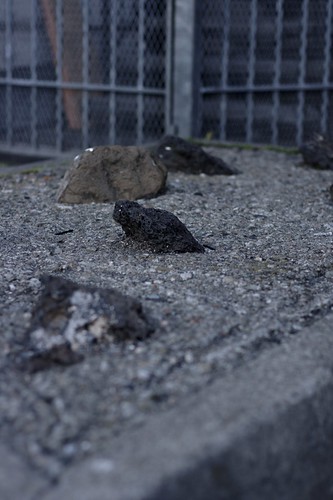
With homelessness on the rise (I looked for statistics, but doing statistics on the homeless is difficult, and the numbers from the recession haven't come out yet, however, I'd like to point to the number of foreclosures and the tent city in Sacramento as proof), I thought I would write about an interesting and sad feature of the urban landscape. Anywhere there is a flat area of concrete you will find rocks turned on end jutting from the surface of the pad. Here you can see a very small island, barely large enough for a person, had rocks strategically placed to discourage laying down on it. 

This type of discouragement was unknown to me until I moved to San Francisco. Now, I see it all over the Bay Area, anywhere there is a slab of concrete, especially when the concrete is protected from the elements. For example, a new bike/ped overpass was installed in Sunnyvale (near my work), and sure enough where the angle of the ramp leaves the bulk of concrete foundation, they placed big rocks on end, closely spaced and jutting up in an unfriendly way. I wonder, how much did those rocks cost to install? Would it have been enough to house and feed a homeless person? Consider design, materials, and implimentation.

Maybe it is about time for us to treat our homeless like humans. I see so many people on the streets of San Francisco, and I always look them in the eye, nod, and say hello. Most of my fellow San Franciscans look forward, blankly, and act as though the homeless don't exist. Personally, I don't think it would be very hard to fall on bad luck, and end up on the street. I don't think it is a choice for most of these people, who typically have serious mental problems, many of which are caused by our own society (take the homeless veterans who account for 23% of the homeless population (!) as a prime example). 

Urban planners of the world, please stop installing these rocks in concrete, it doesn't fix the problem any more than the war on drugs has ended drug abuse. There is a deeper root to the problem that needs to be fixed first. 

Thursday, April 30, 2009

Higher Ed is Broken

This NYTimes article nails the problems with higher education in a way that I can only envy. In one article Mr. Taylor manages to clearly lay out the over arching problems with our education system. Not only that he lays out solutions to the problems quite cleanly:

"1. Restructure the curriculum, beginning with graduate programs and proceeding as quickly as possible to undergraduate programs. The division-of-labor model of separate departments is obsolete and must be replaced with a curriculum structured like a web or complex adaptive network. Responsible teaching and scholarship must become cross-disciplinary and cross-cultural.

2. Abolish permanent departments, even for undergraduate education, and create problem-focused programs. These constantly evolving programs would have sunset clauses, and every seven years each one should be evaluated and either abolished, continued or significantly changed.

3. Increase collaboration among institutions.

4. Transform the traditional dissertation. In the arts and humanities, where looming cutbacks will be most devastating, there is no longer a market for books modeled on the medieval dissertation, with more footnotes than text.

5. Expand the range of professional options for graduate students. Most graduate students will never hold the kind of job for which they are being trained. It is, therefore, necessary to help them prepare for work in fields other than higher education.

6. Impose mandatory retirement and abolish tenure. Initially intended to protect academic freedom, tenure has resulted in institutions with little turnover and professors impervious to change."

Tuesday, April 28, 2009

Monday, April 27, 2009

The Rise of the "Nones"

There is a very interesting article over at NYTimes (again) discussing the rise of the Athiests in this country. They discuss the difference between a poll in 1990 and a poll recently completed in 2008. Here is the jist:

"Polls show that the ranks of atheists are growing. The American Religious Identification Survey, a major study released last month, found that those who claimed “no religion” were the only demographic group that grew in all 50 states in the last 18 years.
Nationally, the “nones” in the population nearly doubled, to 15 percent in 2008 from 8 percent in 1990. In South Carolina, they more than tripled, to 10 percent from 3 percent. Not all the “nones” are necessarily committed atheists or agnostics, but they make up a pool of potential supporters."

Where does this put me?

Now I happen to be Agnostic. In case you don't know what that means, I basically don't believe that either side of the argument has any definitive proof on the existance of God. (Don't get me wrong, I believe in the Big Bang, Evolution, and all that wonderous jazz, not to mention I think that all that hokey crap in Genesis and various other places in the Bible, ie Revelations, is a bunch of fireside tall-tale lengend bullshit.) I mean prove or disprove the existance of God and I will be right there with either the believing or non-believing zealots. But right now, I'm on the fence and happy to be there. Show me proof and I'll hop off. 

So back to my question, Where does this put me? I wouldn't say I'm a non-believer, but I'd also say that I am definately not a believer either. I'd say I'm more comfortable around athiests, but I have some great relationships with very devout Catholics.  Anyway, here is to rationality and the God of the Utterly Indifferent.

Tuesday, April 21, 2009

Student Loans Underwater?

There is a loan term that has been flying around lately, "underwater" is when you owe more than something is worth. Lately, I've been hearing this term used to describe student loans- something people would have considered ludicrous 5-10 years ago. Yet here we are. I read these two (article1 and article2 from NYTimes and Slate respectively) different articles in the last two days describing the situation as the following; students who are educated and skilled cannot get jobs, have to take lower paying much crappier jobs, and can't really keep up on their student loan payments. What is worse is that student loans are FOR LIFE and BEYOND! You cannot claim bankruptcy and get out of student loans, the follow you through the bankruptcy and wait on the other side with accrued interest. What is more is that you can even DIE and they will get passed on to the closest relative. That fact still boggles my mind. 

The first article says that you shouldn't owe more than you will make in one year. After two degrees, I am happy to say that I am managing to say above that low water mark. I am sad to say, barely.

Now for the good news. I found out that all of the interest I payed on student loans (nearly $2,000 for last year alone that's $2,000 I could have burned and gotten more out of) is deductible from your income. This is deductible is in addition to the standard standard whatever $5k deduction, and in addition to the individual whatever $3k deduction. So it is possible to jack yourself into a lower tax bracket by eating rice and living in Wyoming while paying those loans off asap. This was the difference between owing the gov't and having them owe me on this year's return. Also, as the end of that second article points out, if you think that us college graduates are fucked, just imaging how the high school graduates must feel right now...but then again they didn't get sold anything...

Friday, April 17, 2009

Raise the Nation's IQ?

This article from Nicholas Kristoff at the NYTimes discusses a book written by at (ahem) University of Michigan psychology professor Richard Nisbet. Anyone who is interested in education/academia/students and IQ, I suggest you read it.

For me the most interesting section was about telling middle school/high school students that a person's intelligence is malleable and expandable. This is in some (but not all) conflict with the genetic view of IQ, which has scientific support, but there is also support for education/experience increasing a person's IQ. For example, kids IQ goes down over summer break, but then returns to higher levels when school begins again (more reason for more schooling and smaller breaks). Either way, they found that students performed better, got better grades, and generally tried harder when told that they had the power to change their intelligence. In particular girls did better at math because they didn't have the excuse that "Girls don't get math." Instead they were thinking, if I am bad at this, then I can work hard and get better. Now, granted there will always be people who are naturally smarter, and people who are particularly better at one subject versus another, however, I just think that as a principle a you-can-do-whatever-you-put-your-mind-to-philosophy is a good standard to set.

Bolinas Sea Wall

Do you like this program or think it sucks? Having fun with it or think that it is annoying?
I also published the full version over at the photoblog.